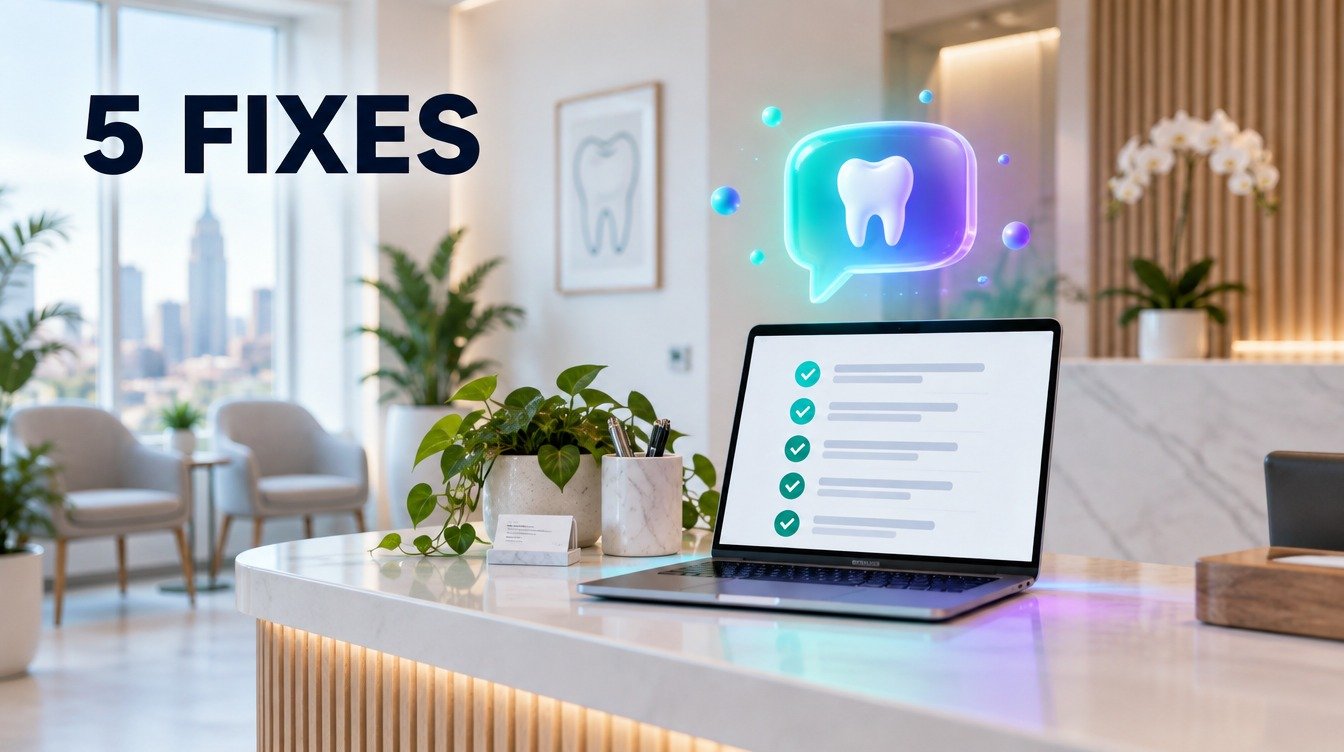
5 Fixes That Make Your Dental Practice Easier for ChatGPT, Gemini, and Google AI to Recommend
What we learned from studying 97 New York City dental websites. Most practices aren’t blocked from AI — they just don’t give it much to work with. Here are the five gaps we found most often, and how to close each one, usually without building a new website.
The short answer
No one can guarantee that ChatGPT, Gemini, or Google’s AI will name your practice. But you can make your website much easier for them to read and trust. In our study of 97 NYC dental practices, the average AI-readiness score was 55 out of 100, and the same five gaps showed up again and again:
| Fix | What we found | Typical effort |
|---|---|---|
| 1. Answer patient questions on your homepage | 52% had no FAQ at all | An afternoon |
| 2. Add Dentist structured data | 29% had none | An hour |
| 3. Write your credentials as text | Only 9% had 2+ trust signals | An hour |
| 4. Make sure your content is in the page itself | 18% had under 300 words | Varies |
| 5. Keep your details identical everywhere | Not measured in our study | A few hours |
Why this matters now: 45% of consumers used AI tools to find local businesses in the past year, up from 6% the year before (BrightLocal, 2026). Yet ChatGPT recommends only about 1.2% of local businesses (SOCi, 2026). And it isn’t only ChatGPT anymore — its share of AI referrals to websites fell to a record low of 76.85% in April 2026 while Google Gemini grew to 9% (Statcounter). The fixes below help with all of them, because they make your site clearer to any AI that reads it.
The five fixes
Answer the questions patients actually ask — on your homepage
52% of homepages had no FAQ · only 6% had FAQ that AI can fully parsePeople ask AI questions in full sentences: “Do they take new patients?”, “Do they accept my insurance?”, “Is there weekend emergency care?” AI answers most confidently from pages that already answer those exact questions.
What to do: Ask your front desk for the 5–8 questions they hear every week. Add them to your homepage with short, direct answers (two or three sentences each). Then mark them up with FAQPage structured data so AI can read them as a clear list of questions and answers.
Tell AI, in code, that you are a dental practice
29% of sites had no structured data of any kindStructured data is a small block of code that states your basic facts in a format machines read reliably. Without it, AI has to guess your name, address, hours, and specialty from your page design — and it can guess wrong.
What to do: Add Dentist structured data (a type of LocalBusiness) with your practice name, address, phone number, hours, and website. Many website platforms and SEO plugins can generate it; your web developer can add it in under an hour.
Write your credentials as plain text, not just logos
Only 9% stated two or more concrete credibility signalsWhen AI names a handful of practices, it leans toward ones it has clear reasons to trust. Most homepages in our study had a phone number or an About link, but few said anything specific about why the practice is credible.
What to do: Add one or two sentences such as “Serving Park Slope since 2004” or “Dr. Lee is a board-certified periodontist.” Badges and association logos are fine, but AI reads words — so say it in text as well.
Make sure your content is in the page itself
18% of homepages had fewer than 300 words of readable textSome websites load their text with JavaScript after the page opens. People see it, but many AI crawlers don’t: the crawlers behind ChatGPT, Claude, and Perplexity generally read a page’s HTML without running JavaScript (Google’s Gemini is an exception).
What to do — a 30-second test: Open your homepage, right-click, and choose “View Page Source.” Press Ctrl+F (Cmd+F on Mac) and search for a sentence you can see on your page. If it isn’t in the source, AI crawlers that don’t run JavaScript probably can’t see it either. Ask your web developer to render that content directly in the HTML.
Keep your name, address, and phone identical everywhere
Not measured in our homepage study — but widely recommendedAI doesn’t rely on your website alone. It cross-checks what other sites say about you — your Google Business Profile, Yelp, Healthgrades, Zocdoc, insurance directories, and local news. When those sources disagree (an old phone number, a previous address), AI has less confidence in any single answer.
What to do: Search your practice name and check the first two pages of results. Correct any listing where your name, address, phone number, or hours differ from your website. And when a local newspaper or association mentions you, link that coverage from your site — trusted third-party sources carry real weight with AI.
One piece of good news from our study: only 3% of practices block major AI crawlers in their robots.txt file. In almost every case, AI can get in. These fixes are about giving it something useful to read once it does.
A 10-minute self-check
- Does your homepage answer at least five real patient questions in text?
- Does your site have Dentist structured data? (Paste your URL into Google’s free Rich Results Test or the Schema.org Validator.)
- Does your homepage state at least two specific credentials in words?
- Can you find a sentence from your homepage in “View Page Source”?
- Do your Google Business Profile and Yelp listings show exactly the same name, address, phone, and hours as your website?
- Ask ChatGPT or Gemini a question a patient would ask, like “family dentist in [your neighborhood] that takes new patients.” Note who it names and which sources it cites.
Or run all of the website checks at once with our free AI-Readiness Checker — it reviews the same 13 signals used in our study.
Don’t have a web developer, or would rather not deal with it? GoCited can set up all five fixes for you.
Frequently asked questions
How do I get my dental practice recommended by ChatGPT?
No one can guarantee a recommendation, but you can make your practice much easier for ChatGPT and other AI tools to read and trust. Answer common patient questions on your homepage, add Dentist structured data, state your credentials in plain text, make sure your content appears in the page’s HTML, and keep your name, address, and phone number identical across every listing.
Do I need a new website to be recommended by AI?
Usually not. In our study of 97 NYC dental practices, the most common gaps — missing FAQ content, missing structured data, and credentials that weren’t written as text — can typically be fixed on an existing website in a few hours to a few days.
Is optimizing for ChatGPT enough?
No. ChatGPT is still the largest AI chatbot, but its share of AI referrals to websites fell to a record low of 76.85% in April 2026 while Google Gemini grew to 9%, according to Statcounter. The fixes in this guide help with ChatGPT, Gemini, Google AI Overviews, and Perplexity alike, because they make your website clearer to any AI that reads it.
What is Dentist structured data?
It is a small block of code, based on the Schema.org standard, that tells search engines and AI tools in a machine-readable way that your business is a dental practice, along with your name, address, phone number, and hours. In our study, 29% of NYC dental websites had no structured data at all.
Disclosure. GoCited is a web and AI-visibility studio that helps businesses with the issues described here. Every fix in this guide can be done by you or your current web developer.
See where your practice stands
Run the same free test we used in our study. No signup required.
Check my site free